
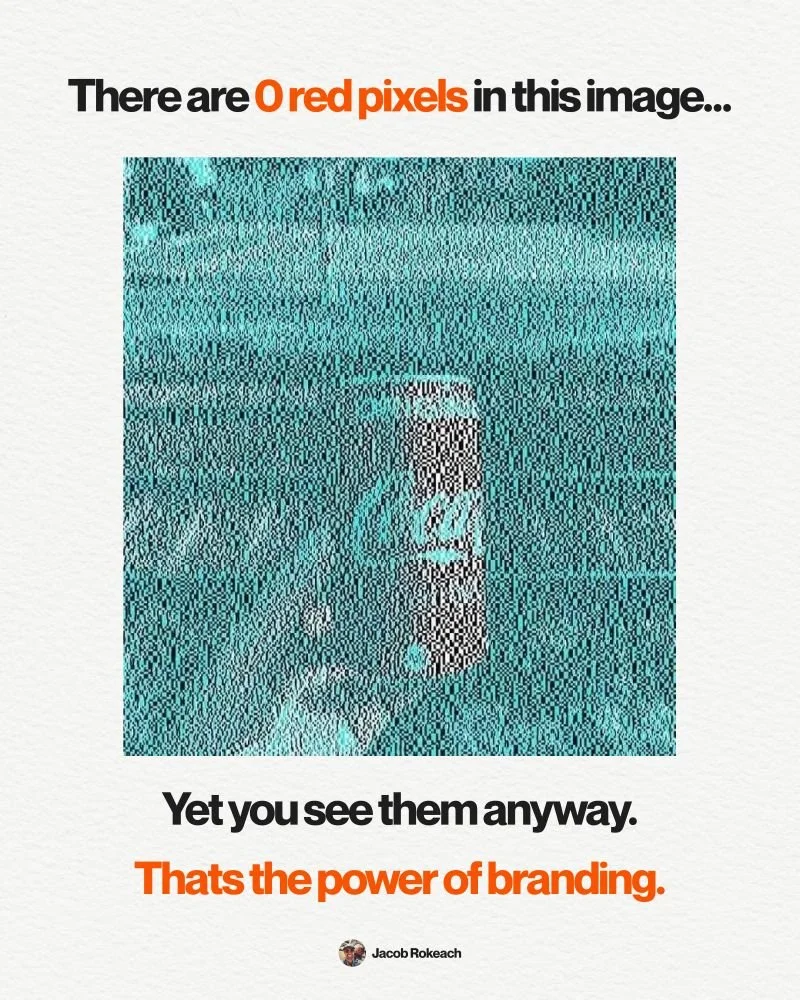
Your brain just painted this can red.
Yet there isn't a single red pixel in this image.
It's only cyan, black, and white pixels.
Your brain is constantly adjusting colors for the lighting around them.
So it reads the cyan as a tint, cancels it out, and pushes the can toward red.
And knowing a Coke can is supposed to be red makes the effect even stronger.
For Coca-Cola, that's years of repetition doing the work.
They've put the same red on everything from cans to Christmas trucks for so long that your brain is ready for it the second the can appears.
That's the kind of recognition every brand wants.
People don't need the full picture to know it's you.
Here's how your brand can earn that same kind of recognition:
1️⃣ Repeat one thing until it sticks
↳ Coca-Cola has pushed the same red for decades, and now people expect it before they see it.
↳ Recognition comes from repetition, instead of a one-off campaign.
2️⃣ Own one distinctive asset
↳ A color, a shape, a phrase, whatever it is.
↳ Pick the one thing people would still recognize if your logo disappeared.
3️⃣ Keep it simple
↳ The simpler the asset, the faster people learn it, and the longer they remember it.
↳ 1 color is far easier to remember than a visual system with 6 moving parts.
4️⃣ Don't change it too soon
↳ Every time you switch, people have to learn it all over again.
↳ Teams usually get tired of a brand asset long before customers even start to notice it.
A strong brand is one your audience can recognize with half the information missing.
That kind of recognition takes years of showing the same thing, the same way, until people stop needing the rest of the picture.
Getting bored of your brand is usually a sign it's starting to work.
If you stripped away your logo and your name, what would people still recognize about your brand?
♻️ Repost for the team that wants to refresh the brand color again.
And follow me, Jacob Rokeach, for more on brand and creative systems that scale.
Brand Recognition Is Built Through Repetition, Not Reinvention
Previous
Previous
How Canva Turned 14 Billboards Into a Live Product Demo
Next
Next