
Claude Hopkins’ 10 Rules of DTC Marketing
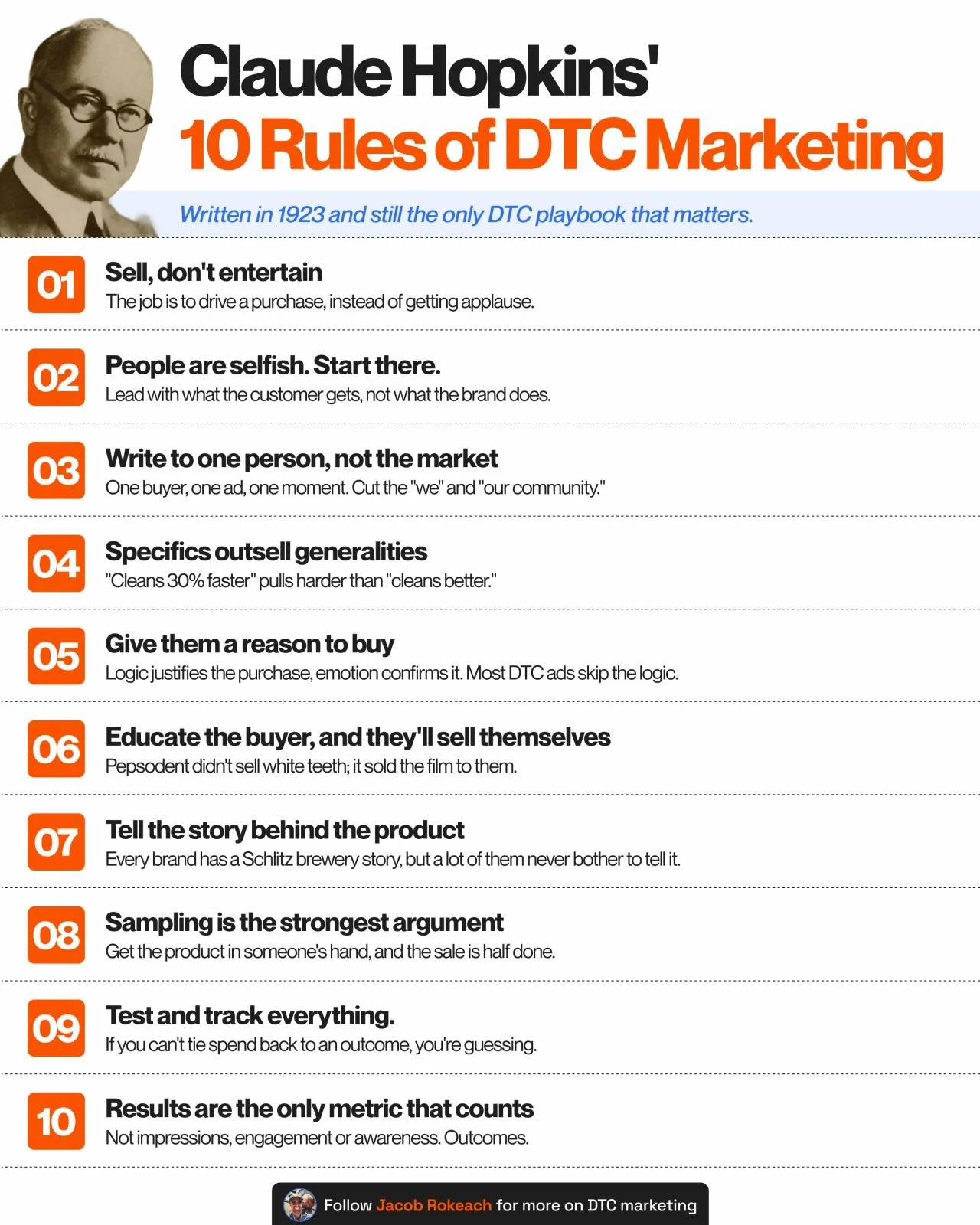
Most DTC operators have never heard the name Claude Hopkins.
But his rules still shape today's paid social ads, lifecycle emails, and PDPs.
Hopkins ran direct response campaigns in the 1910s and 20s for brands like Pepsodent, Palmolive, and Schlitz Beer.
He turned advertising from guesswork into a measurable system,
using coupons and sales data to tie spend back to results.
In 1923, he put it all in a book called Scientific Advertising.
David Ogilvy, one of the most influential ad men of the last century, read it every year.
Jeff Bezos made every Amazon executive read it too.
The reason it still gets passed around 100 years later is simple:
Hopkins figured out modern DTC before modern DTC existed.
Here are 10 of his lessons, and why they still hold up in DTC marketing today 👇
1️⃣ Sell, don't entertain
↳ The job of an ad is to drive a purchase, instead of a reaction.
↳ Ask if your last campaign was built to sell or just to be seen.
2️⃣ People are selfish, start there
↳ Buyers care about what they get, not what your brand stands for.
↳ Rewrite your next headline around the customer's outcome.
3️⃣ Write to one person, not the market
↳ One buyer, one ad, one moment. "We" and "our community" dilute that.
↳ Swap "we" for "you" in your next post.
4️⃣ Specifics outsell generalities
↳ "Cleans 30% faster", hits harder than "cleans better."
↳ Replace one vague line in your next ad with an exact detail.
5️⃣ Give them a reason to buy
↳ Emotion gets attention, logic closes the sale. A lot of DTC ads skip the logic.
↳ Add one line of proof or reasoning to your next ad.
6️⃣ Educate the buyer, and they sell themselves
↳ Pepsodent never sold white teeth. It sold the film on your teeth and the fix for it.
↳ Find the education angle in your product before writing the next ad.
7️⃣ Tell the story behind the product
↳ Every brand has an origin worth telling, but too many of them don't bother.
↳ Write down the real reason your product exists and use it.
8️⃣ Sampling is the strongest argument
↳ Get the product into someone's hands, and the sale is already half made.
↳ If you can offer a sample or trial, make it easier to take.
9️⃣ Test and track everything
↳ If you can't tie spend back to an outcome, you're guessing.
↳ Pick one channel this week and confirm what it's driving.
🔟 Results are the only metric that counts
↳ Impressions and engagement don't pay the bills. Revenue and repeat purchases do.
↳ Before your next report, swap one vanity metric for a revenue number.
If your team is running spend you can't tie back to outcomes,
briefing creative without a single clear message, or leading every ad with vibes and no reason to buy.
Hopkins already wrote the fix.
The tools are new.
The problems are not.
Which of these do you still see DTC teams getting wrong?
♻️ Repost for another operator who needs the reminder.
Follow me, Jacob Rokeach, for more on building DTC growth systems.