
Problem Thinking vs. Puzzle Thinking
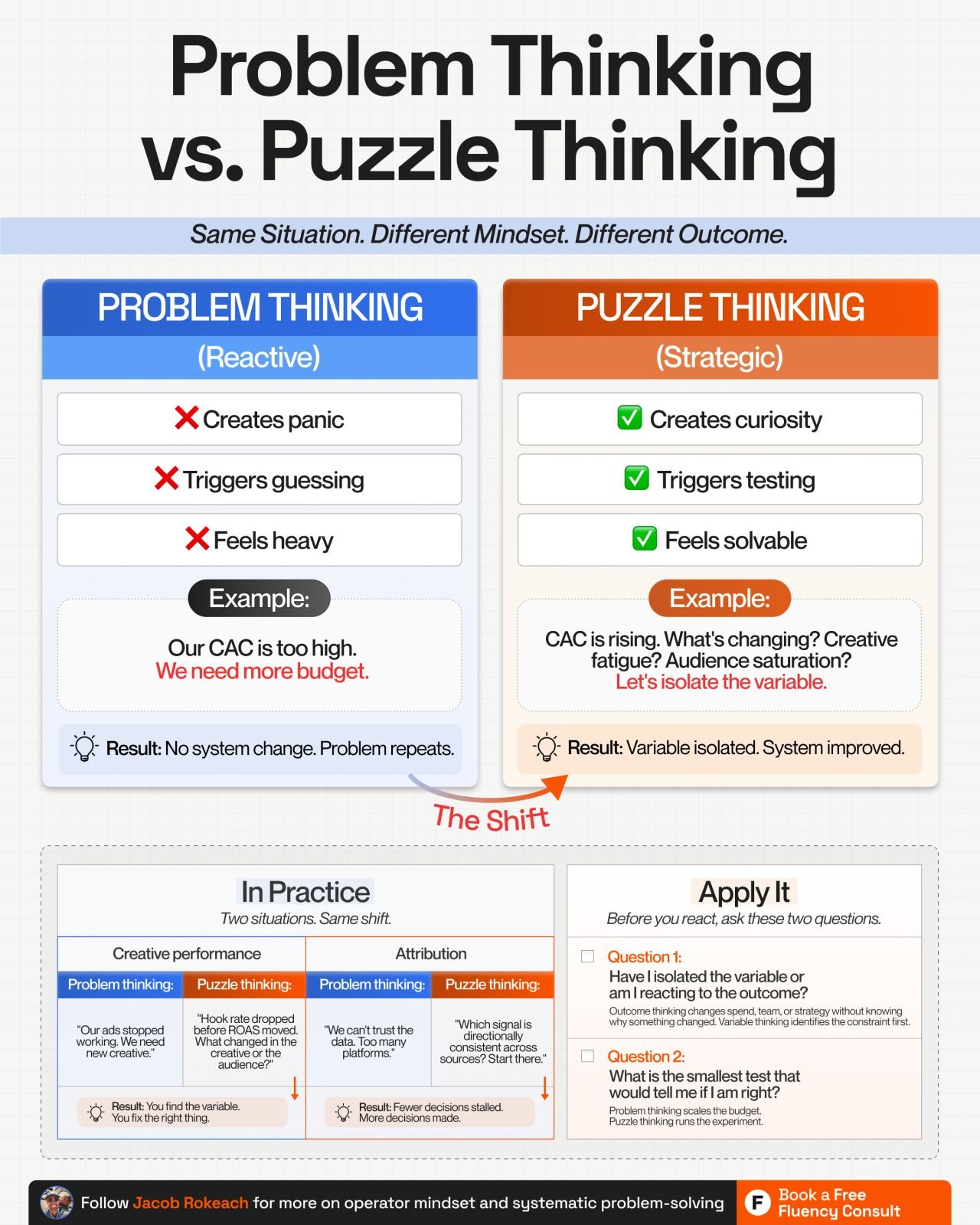
Problems are puzzles.
And the operators who scale solve them faster.
For most of my career, I treated problems as barriers.
Things to stress about and avoid.
Things that meant I was doing something wrong.
Then I shifted my perception.
Now I treat them like puzzles.
That single shift changed how I operate.
Because a puzzle creates curiosity instead of panic.
Creativity instead of fear.
It slows you down enough to see the patterns.
When you name something as a puzzle, not a threat, you unlock the resourceful part of your brain.
The part that isolates variables, asks better questions, and builds systems to prevent it happening again.
I think about this phrase a lot: "Life happens for me, not to me."
When something breaks, when a client churns, when a plan falls apart.
I don't ask "Why me?"
I ask, "What is this showing me?"
That turns frustration into information.
Because on the other side of every puzzle is a new system or a clearer decision framework.
Here's what this looks like:
🤯 Problem thinking.
↳ "Our CAC is too high. We need more budget."
🧩 Puzzle thinking.
↳ "CAC is rising. What's changing? Creative fatigue? Audience saturation? Let's isolate the variable."
🤯 Problem thinking.
↳ "Open rates dropped. Email is dying."
🧩 Puzzle thinking.
↳ "Deliverability shifted, or message relevance dropped. Which one? Let's test separately."
🤯 Problem thinking.
↳ "Conversion rate tanked this week. Something's broken."
🧩 Puzzle thinking.
↳ "Conversion dropped 15%. Traffic is flat. What changed on-site? Inventory? Load speed? Let's check the last 3 deploys."
You can see the difference.
Problem thinking creates panic and guessing.
Puzzle thinking creates curiosity and testing.
The operators I respect get curious when things break.
They ask better questions. They isolate variables.
They adjust without overcorrecting.
That's what separates reactive operators from strategic operators.
So, next time something heavy hits, shift one word:
Call it a puzzle, not a problem.
Then ask:
- What's the real variable?
- What pattern am I missing?
- What system could I build so this doesn't happen again?
Yes, it might sound easier said than done.
But the more you practice, the faster you get at solving what used to break you.
What's a puzzle you're working through right now?
Drop it in the comments. I'll help you reframe it.
If you're doing $30M+ and need a partner who treats your business like a puzzle, not a panic, hit the link below to book a Free Consult.
👉 https://lnkd.in/dD6SNFen
♻️ Repost if you've ever let a problem sit too long because it felt too heavy to solve.
Follow me, Jacob Rokeach, for more on operator mindset and systematic problem-solving.