
How the Fluency Flywheel Works
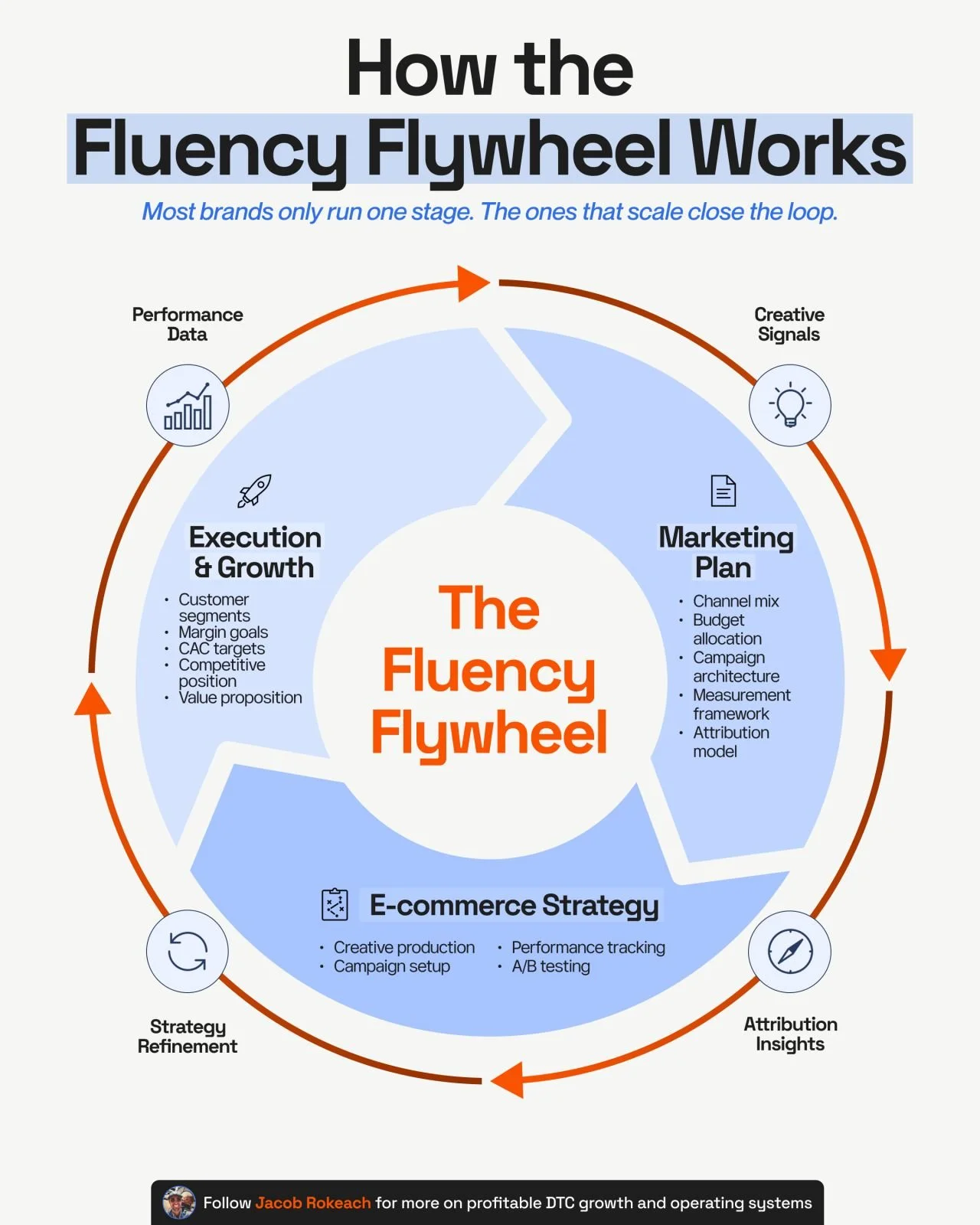
Most e-commerce brands are spending money in the wrong layer.
Here's why your results feel random:
I've worked with 100+ DTC brands at Fluency Firm.
Brands jump straight to execution (launch ads, test creative, optimize landing pages) without strategy or structure.
They dont get the results, then they blame the tactics.
Yeah, these tactics can work.
But they can't fix a missing foundation.
Here's the breakdown:
There are 3 layers to e-commerce marketing.
Layer 1️⃣: Strategy
What does success look like?
Revenue targets, margin goals, CAC targets.
Who are we talking to?
What's our competitive position? What are we optimizing for?
Without this, execution is just activity.
Layer 2️⃣: Marketing Plan
Channel mix. Budget allocation. Campaign architecture. Measurement framework.
Most brands skip this entirely.
They go from "we need to grow" straight to "let's launch Meta ads."
Layer 3️⃣: Execution
Creative production. Campaign setup. Performance tracking. Testing and iteration.
Execution should be more than output.
It's a system that feeds data back into better decisions.
This is where the Fluency flywheel starts.
Because we know that the brands that scale don't just execute.
They have a flywheel that turns execution into intelligence:
→ Performance data surfaces what's working
→ Creative gets smarter based on those signals
→ Attribution shows where to double down
→ Insights flow back into strategy
Each layer informs the next.
That's how you get consistent, repeatable growth instead of random wins.
If your results feel inconsistent, it's because you're likely:
👉 Missing the foundation (no strategy or plan, just tactics)
👉 Not closing the loop (execution generates data, but it doesn't flow back into decisions)
If you're spending all your time executing, you're working hard without building the systems that make decisions clearer over time.
What layer is your brand spending the most time on right now?
Let me know in the comments.
If you're doing $30M+ and your growth feels reactive instead of systematic, let's chat and I'll show you our framework for growth.
We'll walk through where the breakdown is and how to close the loop.
📍 https://lnkd.in/dD6SNFen
♻️ Repost if your growth feels random right now.
And follow me, Jacob Rokeach, for more on building growth systems that scale.